Time Card Rounding & the 7-Minute Rule
The full table, the legality test, and a calculator that reproduces payroll's math.
7-minute rule
9:00
15-minute truncation
8:45
Difference vs exact
+7 min
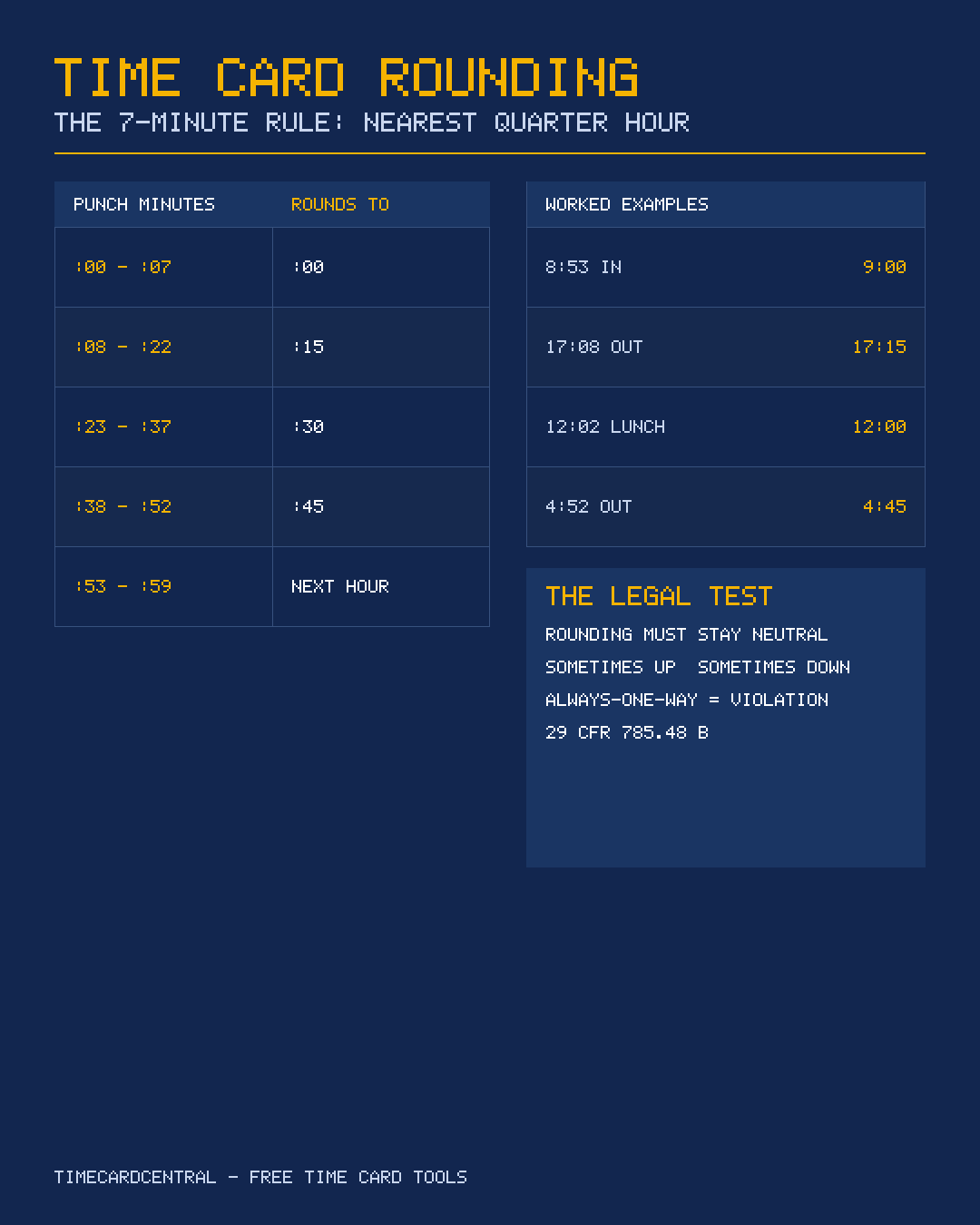
The table
| Minutes on the punch | Rounds to |
|---|---|
| :00 | → :00 |
| :07 | → :00 |
| :08 | → :15 |
| :14 | → :15 |
| :15 | → :15 |
| :22 | → :15 |
| :23 | → :30 |
| :29 | → :30 |
| :30 | → :30 |
| :37 | → :30 |
| :38 | → :45 |
| :45 | → :45 |
| :46 | → :45 |
| :52 | → :45 |
| :53 | → next hour |
| :59 | → next hour |
The four rounding modes you'll meet
| Mode | How it works | Typical user |
|---|---|---|
| 7-minute rule | Nearest :15 (up on :08+, down to :07) | Traditional punch clocks |
| 15-minute truncation | Always down to :15 — favorable to employer | Some legacy systems; legally fragile |
| Hundredths (0.01 h) | Rounds to 36 seconds; modern standard | Digital systems, ADP/Gusto |
| No rounding (exact) | Minutes as punched | Modern time clocks; the safest default |
The legality test in plain English
Rounding must be neutral over time: sometimes it helps you (7:58 → 8:00), sometimes the employer (4:52 → 4:45). If the system only ever rounds one direction — or if punch data shows it nets against workers over months — that's the fact pattern regulators and courts act on. Keep your own punch records; they're the evidence.
Printable 7-minute rule chart

Frequently asked questions
What is the 7-minute rule?
Punch-time rounding to the nearest quarter hour: minutes :00–:07 round down to :00, :08–:22 up to :15, :23–:37 to :30, :38–:52 to :45, and :53+ up to the next hour. Named for the 7½-minute midpoint (7 minutes in practice), it's the common lawful method.
Is time clock rounding legal?
Yes, federal rules (29 CFR 785.48(b)) allow rounding if it's to a neutral increment and doesn't systematically favor the employer over time. Rounding that always shaves employee time is a violation — and class actions have been won on exactly that pattern.
8:53 AM becomes what?
Under the 7-minute rule, 8:53 rounds UP to 9:00 (53 minutes is past the :52 boundary). 8:52 rounds down to 8:45. The minute matters.
Does rounding apply before or after breaks?
To punches — each in/out timestamp individually. Breaks that are exact (30:00) don't drift; breaks logged as punches round like everything else, which can shave real break time.
How do I check if my employer's rounding is fair?
Track your actual punches for two weeks (photo the clock), then compare against your paycheck's times. The time card calculator with rounding set to “7-minute rule” reproduces payroll's math; differences beyond a minute or two each way, always in the employer's favor, are worth raising.